
Views: 0 Author: Site Editor Publish Time: 2026-03-17 Origin: Site


Ever wondered why some blow molded containers feel stronger, lighter, and cleaner than others? The answer often starts at the parison. In modern manufacturing, parison wall thickness control separates basic production from high‑performance results. When thickness varies, products weaken, resin usage rises, and cooling slows. Today’s markets demand strength, speed, and sustainability—so precision is no longer optional.
Advanced blow molding machine systems, including those from DAWSON, now solve this through intelligent wall thickness control. In this article, you’ll learn how parison control works, why it matters, and how it helps manufacturers cut waste while boosting output.

The parison is the unsung hero in blow molding. It’s a molten plastic tube formed by extrusion or injection. This soft, viscous tube gets trapped between two mold halves, then expanded by compressed air until it takes the shape of the mold cavity. Simple in concept—but complex in behavior.
Here's how it looks before inflation:
Step | Description |
1. Parison Formation | Plastic is extruded vertically from die head |
2. Mold Closing | Mold halves close around the parison |
3. Inflation | Compressed air shapes the part |
4. Cooling & Ejection | Mold opens; part removed |
The problem? Gravity pulls on the molten parison. The top stretches thinner than the bottom. That’s before you even start inflating.
The molten state of the parison makes it susceptible to gravity and stretching. As it hangs vertically, the top portion stretches more than the bottom, thinning unevenly before the mold even closes. This natural sag leads to irregular wall thickness in the finished product.
Without proper control, the thinnest part of a container determines the overall strength, forcing unnecessary overuse of material elsewhere.
AWDS adjusts the wall thickness along the vertical axis by moving the mandrel up or down during extrusion. This changes the die gap over time, allowing for thicker bottoms and thinner tops—or vice versa—depending on the part's structure.
● Ideal for tall containers like bottles or jerrycans.
● Helps prevent weak bases or over-thick necks.
PWDS fine-tunes thickness around the circumference of the parison. It uses servo-driven actuators to flex the die ring, widening or narrowing specific areas of the gap.
● Crucial for oval or asymmetrical products.
● Supports consistent distribution across all axes.
Using both axial and radial controls enables 3D shaping of wall profiles. The result: optimal material distribution and superior performance in complex geometries.
Control System | Main Direction | Best Used For |
AWDS | Vertical | Tall containers, strong bases |
PWDS | Circumference | Oval or asymmetric shapes |
AWDS + PWDS | Full 3D | Complex or multilayer products |
Tip: When producing non-cylindrical or multilayer products, combining AWDS and PWDS ensures tighter control and fewer defects.
Wall thickness control depends on fast, real-time feedback. These systems use closed-loop logic involving:
● Wall thickness controller
● Electro-hydraulic servo valve
● Actuator
● Electronic ruler (position sensor)
This loop ensures the die gap is adjusted immediately when thickness deviates from the programmed profile.
Rather than using one setting for the whole parison, operators can define 30 to 100 control points. Each point can have a unique thickness value. This lets you dial in more thickness at stress points and save resin where it’s not needed.
Point Count | Control Quality | System Reaction |
10–20 | Low | Fast |
30–60 | Medium | Balanced |
100+ | High | Slower |
Interpolation algorithms help create smooth transitions between programmed control points along the parison. Instead of abrupt changes in thickness, the system gradually adjusts the die gap, ensuring consistent wall flow throughout the extrusion.
This process minimizes the risk of visible seams, weak zones, or uneven material buildup. It also improves structural integrity and surface aesthetics in finished products. Smoother transitions reduce downstream defects and ensure better compatibility with automated inspection or quality control systems, especially in high-throughput environments.
One of the clearest benefits? Lower material usage. Instead of thickening the entire container just to meet the minimum thickness at one weak point, wall thickness control puts resin only where it’s needed.
Take this real-world case:
Product | Weight Without Control | Weight With Control | Resin Saved |
501 Drum (wide mouth) | 3.5 kg | 2.4 kg | 1.1 kg (≈30%) |
Over hundreds of cycles per day, that’s serious savings.
Controlled parison thickness leads to structural uniformity throughout the finished product. This reduces failure rates, enhances mechanical strength, and improves the overall strength-to-weight ratio, even in complex designs.
● Minimizes risk of weak points in high-stress zones.
● Supports tighter tolerances and better customer satisfaction.
Thinner and more uniform sections cool much faster, which shortens mold cycle time significantly. This directly increases hourly output and reduces energy consumption over each production run.
Uniform wall thickness means faster production, less downtime between cycles, and consistent quality across shifts—even during extended high-volume operations.
Here's the trade-off: if you want ultra-fine control, you need more control points. But more points mean slower response times. The trick is choosing the right balance for your product.
Factor | Fewer Points (Fast) | More Points (Accurate) |
Speed | High | Medium |
Accuracy | Low | High |
Best For | Simple shapes | Complex geometries |
Each component must operate seamlessly:
● Controller: Stores the wall profile; handles logic
● Servo Valve: Converts signals into mechanical action
● Actuator: Moves mandrel or die ring
● Electronic Ruler: Measures motion; feeds it back
This closed-loop system ensures precision without manual adjustments.
Brands like DAWSON integrate high-end control software like DIGIPACK directly into their blow molding machines. These systems allow up to 100-point control and support both continuous extrusion and accumulator-based designs. DAWSON’s platforms ensure accuracy even with thick-walled or multi-cavity molds.
● Large containers (e.g., 20L drums) need more complex control strategies to prevent base thinning and sidewall distortion during forming.
● Small bottles benefit from faster AWDS profiles, allowing quicker response and more precise material placement along the parison length.
● Cylindrical parts: axial control often suffices for achieving consistent wall thickness and stable production.
● Asymmetrical or contoured parts: require radial control to ensure even distribution across curves, corners, and transition zones.
Industry | Requirement | Control Focus |
Pharma | Clean lines, consistent dosing volumes | AWDS |
Chemicals | Thick walls for aggressive contents | PWDS + AWDS |
Food & Beverage | Lightweight with integrity | Balanced both |
Tip: Multi-layer containers—like those with oxygen barriers—depend heavily on precise wall thickness control for each layer.
Wall thickness control gives manufacturers greater adaptability across product lines.
● Switch between product types faster without major hardware changes.
● Produce complex or custom wall profiles with minimal changeover and reduced setup time.
● Support both short-run and high-volume production with consistent quality.
More precise control means fewer rejects and more efficient resin use.
● Less scrap = lower material cost per unit, especially in large-scale runs.
● More throughput per machine = higher ROI and better utilization of factory floor space.
With over 18 years of industry expertise, DAWSON provides complete blow molding machine systems designed for performance, precision, and adaptability. Their technology is trusted in over 45 countries and backed by global service support.
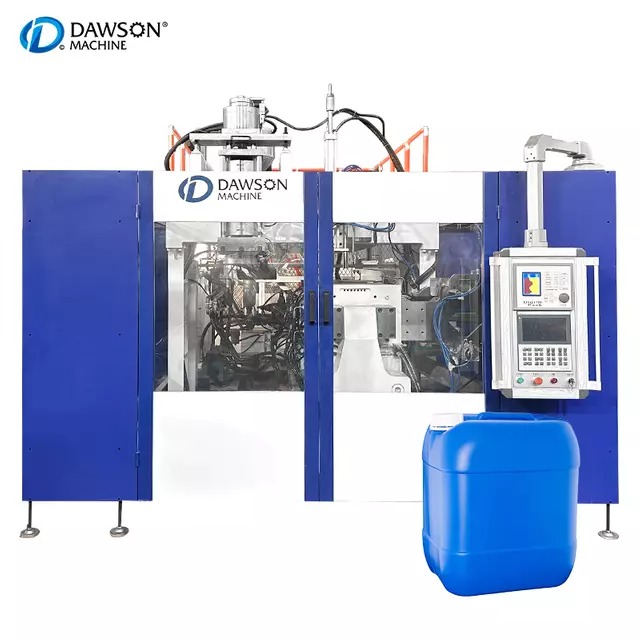
Parison wall thickness control has become a core requirement in modern blow molding, helping manufacturers reduce resin use, shorten cooling cycles, and improve product strength. By applying AWDS and PWDS technologies, producers gain precise control over material distribution across the entire forming process, enabling lighter parts, stable quality, and higher output from every blow molding machine. As production demands grow and product shapes become more complex, integrated wall thickness control systems deliver measurable gains in efficiency and consistency.
ZHANGJIAGANG DAWSON MACHINE CO.,LTD. provides advanced blow molding solutions that combine intelligent control, reliable machine performance, and professional technical support. Their systems help manufacturers optimize operations, reduce waste, and achieve long-term production value—making wall thickness control a practical investment for better quality and stronger profitability.
A: It refers to adjusting the thickness of the molten plastic tube (parison) during extrusion. This ensures even wall distribution, improving product quality and reducing material waste.
A: A blow molding machine uses systems like AWDS and PWDS to control wall thickness both axially and radially. These systems dynamically modify the die gap during extrusion for uniform results.
A: Without it, parts may have thin areas that compromise strength or require excess resin to meet standards. Controlling thickness reduces defects, material use, and cooling time.
A: DAWSON integrates advanced control systems like DIGIPACK into its blow molding machines, enabling accurate wall profiling and helping manufacturers produce lighter, stronger products more efficiently.
A: Yes. Combined AWDS and PWDS systems are ideal for asymmetrical or multilayer parts where precise 3D wall shaping is required.
A: Absolutely. It cuts resin consumption by up to 30%, reduces scrap, and increases cycle efficiency, resulting in long-term savings for blow molding operations.