

Views: 0 Author: Site Editor Publish Time: 2026-07-13 Origin: Site


In high-volume extrusion blow molding, the tension between cycle time reduction and scrap rate minimization is constant. Pushing machinery to run faster often yields diminishing returns if part integrity is compromised. Increasing extruder RPM theoretically boosts production volume, but it introduces complex thermal and mechanical variables. Uncalibrated speed increases lead to unstable melt flows, parison defects, and disproportionate energy spikes, ultimately eroding profit margins.
Resolving this requires a technical evaluation of how screw speed interacts with resin rheology, screw design, and machine controls. This guide breaks down the operational trade-offs of screw speed adjustments to help production teams maximize profitable yield without sacrificing part quality. We will examine the mechanical limits of plasticizing capacity, the thermal realities of high-shear environments, and the downstream cooling requirements necessary to support elevated throughput.
Speed vs. Melt Homogeneity: Higher screw speeds increase shear heating, which can lead to thermal degradation and inconsistent parison formation if barrel cooling systems cannot compensate.
Non-Linear Output Gains: Doubling screw RPM does not equate to double the usable output; volumetric efficiency often drops at higher speeds due to pressure build-up and material slip.
Variable Control is Mandatory: Utilizing Variable Speed Drives (VSDs) is critical for adapting to different resin profiles, part weights, and environmental variables, offering precise control over the extrusion process.
Quality Bottlenecks: The primary limiting factors for maximum screw speed are melt fracture, parison sag, and surface finish defects, which dictate the practical upper limit of production rates.
The Cooling Rate Bottleneck: Increased throughput requires proportional heat removal; if mold cooling rates cannot match the thermal load of a high-speed melt, part warpage and dimensional instability will occur regardless of screw performance.
Establishing baseline metrics for volumetric efficiency, residence time, and melt uniformity is required before adjusting RPM. Without these benchmarks, speed increases become guesswork, leading to unpredictable part quality and machine wear. Operators must understand the physical limitations of the extruder barrel and the screw geometry before attempting to force higher throughput.
Excessive speed can outrun the heat transfer capability of the screw, leading to incomplete melting. The physical solid conveying in the feed zone must balance with the melting capacity in the transition zone. If the screw rotates too fast, solid pellets are pushed forward before they fully plasticize, causing unmelts and structural weaknesses in the final part. The feed throat must remain cool enough to prevent premature melting and bridging, while the transition zone must have sufficient residence time to apply shear and conductive heat.
Extrusion Zone | Primary Function | Impact of Excessive Screw Speed |
|---|---|---|
Feed Zone | Solid conveying and pre-heating | Pellet bridging, inconsistent feed rates, and loss of grip on the barrel wall. |
Transition Zone | Compression, melting, and shear application | Incomplete plasticization, unmelts passing through, and severe shear spikes. |
Metering Zone | Pumping and melt homogenization | Thermal degradation, surging, and erratic head pressure at the die. |
The relationship between screw rotation, conveying capacity, and the continuous formation of the parison is direct. Higher speed increases the shear rate and the mechanical work applied to the polymer. This mechanical work generates frictional heat, altering the melt viscosity and directly impacting how the parison hangs from the die head. When you increase the RPM, you are not just pushing more plastic; you are fundamentally changing the thermal profile of the melt.
To properly calibrate this relationship, operators should follow a strict sequence:
Record the baseline head pressure and melt temperature at the current stable RPM.
Increase the screw speed in small increments (e.g., 2-5 RPM).
Allow the barrel temperature zones to stabilize for at least 10-15 minutes.
Measure the new melt temperature using a hand-held pyrometer on a purged sample.
Observe the parison for changes in sag, swell, and surface finish.
Adjust the die gap or parison programming profile to compensate for the new melt behavior.
Theoretical output (drag flow) diverges from actual output (net flow) at high speeds. Evaluating the impact of head pressure and die restriction on high-speed extrusion efficiency reveals that as RPM increases, backpressure often rises, reducing volumetric efficiency. Addressing melt pressure stability is necessary to prevent surging and head pressure fluctuations at elevated RPMs. The polymer melt begins to slip against the barrel wall rather than being conveyed forward, meaning you consume more motor power for diminishing returns in actual plastic delivered to the mold.
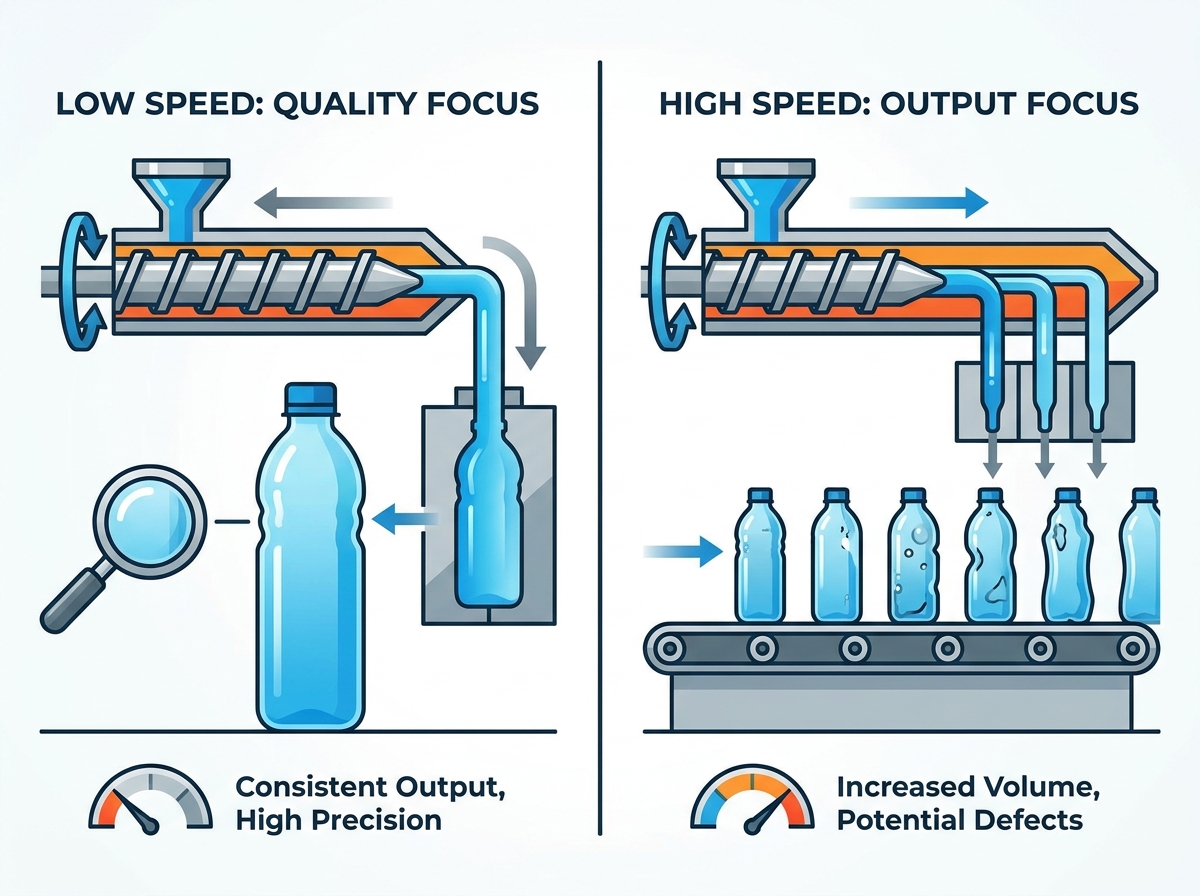
Pushing output limits often introduces defects that negate the benefits of faster cycle times. Understanding these hidden costs is vital for maintaining profitability. A machine running at 110% capacity but producing 15% scrap is far less efficient than a machine running at 90% capacity with a 1% scrap rate.
Excessive shear heating at high RPMs causes localized polymer degradation. The effect of uneven melt temperatures on the structural integrity of the final blown part includes weak weld lines and brittle sections. If the barrel cooling cannot remove this excess heat, the resin degrades, leading to discoloration and loss of mechanical properties. You will often see black specks or yellowing in clear or white resins when the shear heat exceeds the polymer's thermal stability threshold.
Rapid extrusion alters die swell characteristics, complicating parison programming. The correlation between high-speed melt delivery and increased parison sag is driven by elevated melt temperatures reducing melt strength. Furthermore, extreme output speeds cause erratic parison swing (curling or snaking) at the die exit, leading to uneven wall distribution during mold clamping. The parison becomes too fluid to support its own weight, stretching excessively at the top and pooling at the bottom before the mold can close.
Identifying the critical shear stress threshold where smooth melt flow transitions to melt fracture (sharkskin or gross fracture) is necessary. High speeds can cause "unmelts" (unplasticized resin pellets) and color dispersion streaks under insufficient residence time. Evaluating the trade-off between cycle time reduction and the cost of rejecting parts with poor surface finish is a daily operational challenge. Sharkskin appears as a rough, matte finish on what should be a glossy part, directly resulting from the melt tearing as it exits the die too quickly.
Faster production is only profitable if the energy costs and scrap rates do not exceed the value of the additional parts produced. The extruder motor is typically the largest consumer of electricity on the machine, and its power draw increases exponentially, not linearly, with speed.
A framework for measuring the Specific Energy Consumption (SEC)—the energy required per kilogram of extruded plastic (kWh/kg) at varying speeds—helps determine actual efficiency. Assessing the point of diminishing returns where energy costs and scrap rates outpace the value of increased production volume prevents unprofitable scaling. You must track the kilowatt draw of the main drive motor against the actual weighed output of good parts per hour.
Evaluating VSDs as a standard requirement for modern extrusion lines shows significant benefits. Precise motor control reduces energy spikes and allows for micro-adjustments during the production cycle to adapt to fluctuating material viscosities, ensuring stable output without wasting power. Older machines with DC drives or simple AC contactors cannot provide the granular control needed to optimize SEC at high throughputs.
Different polymers react uniquely to shear and heat, dictating maximum allowable screw speeds. You cannot run a heat-sensitive material at the same RPM as a highly stable commodity resin.
HDPE: High tolerance for speed but susceptible to melt fracture at extreme shear rates. It requires aggressive cooling in the mold to set the thick walls quickly.
PET: Highly sensitive to residence time and shear heating; requires strict speed limitations to prevent acetaldehyde formation and IV (intrinsic viscosity) drop. Over-shearing PET destroys its structural integrity.
PVC: High risk of thermal degradation; mandates low, highly controlled screw speeds and specialized, chrome-plated screw geometries to prevent the release of corrosive hydrochloric acid gas.
Variations in bulk density between virgin pellets and regrind affect feeding efficiency at high speeds. Strategies for stabilizing output when running high percentages of post-consumer recycled (PCR) materials, which have unpredictable rheological behaviors, include adjusting feed throat temperatures and utilizing grooved feed sections. Regrind often feeds poorly at high RPMs, causing the screw to starve and the parison length to fluctuate wildly.
When high-speed production causes issues, operators need actionable steps to restore stability. Guessing at temperature changes or randomly adjusting timers will only compound the problem.
A step-by-step diagnostic sequence is needed when encountering production halts due to sudden surging or melt defects. Immediate corrective actions involve differentiating when to adjust screw speed versus adjusting barrel zone temperatures. Often, lowering speed slightly resolves surging faster than waiting for temperature zones to stabilize.
Verify that the feed throat cooling water is flowing and the throat is cool to the touch.
Check the main drive motor load (amps); erratic spikes indicate feeding issues or unmelted material binding the screw.
Inspect the parison for unmelts or bubbles, which suggest the RPM has exceeded the plasticizing capacity.
Reduce screw speed by 10% and observe if the head pressure stabilizes.
If stability returns, gradually increase speed while simultaneously increasing the transition zone temperature by 5-10 degrees to aid melting.
Evaluating when to replace standard flighted screws with barrier screws helps maintain melt quality at higher RPMs. The role of Maddock or pineapple mixing sections in resolving thermal inconsistencies and color streaks caused by fast extrusion is significant, ensuring a homogenous melt even at high throughputs. A barrier screw physically separates the solid bed from the melt pool, allowing for much higher RPMs without pushing unmelts through the die.
Assessing the capacity of existing barrel cooling systems (air vs. liquid) to handle increased shear heat is critical. Implementing reverse temperature profiles can mitigate overheating in the metering zone, preventing polymer degradation before it reaches the die head. If the cooling fans are running constantly but the zone temperature continues to climb, the screw speed is generating too much frictional heat for the system to reject.
Synchronizing mold cooling capacity (chiller temperatures, water flow rates) with the higher heat load of high-speed melts prevents post-mold warpage. If the mold cannot cool the part fast enough, the speed gains at the extruder are lost during the cooling phase. You must ensure turbulent flow in the mold cooling channels to maximize heat transfer.
Using multi-point parison control systems counteracts the unpredictable die swell and sag introduced by high-speed extrusion. This allows for dynamic adjustments to wall thickness, ensuring part consistency despite variations in melt flow. As the melt gets hotter and sags faster, the programmer must pinch the die gap sooner to maintain the correct weight distribution in the bottom of the bottle.
Screw speed is a critical lever for throughput, but it is entirely constrained by the thermodynamic limits of the resin, the mechanical design of the extruder, and downstream cooling capacities. Treating speed as an isolated variable inevitably leads to quality failures. When evaluating new machinery or retrofits, prioritize systems with robust VSDs, advanced screw geometries tailored to your primary resins, and high-capacity barrel cooling.
Conduct a process audit to map current RPM against scrap rates and energy draw to find your true efficiency peak.
Establish specific shear rate limits and melt temperature maximums for your existing molds and materials.
Calculate Specific Energy Consumption (SEC) benchmarks before attempting to scale output to ensure profitability.
Upgrade to barrier screws with intensive mixing sections if unmelts or color streaks limit your current maximum speed.
Contact us to evaluate your current extrusion setup and identify mechanical upgrade opportunities.
A: There is no single ideal speed. It depends on the resin type, screw design, part weight, and cooling capacity. The optimal speed maximizes output while maintaining melt homogeneity and preventing thermal degradation.
A: Look for signs of unmelts in the parison, severe parison sag, discoloration indicating degradation, or surging at the die head. If surface finish degrades into sharkskin, the speed is likely too high.
A: Higher speeds increase melt temperature and shear, which reduces melt strength. This leads to increased parison sag and unpredictable die swell, causing uneven wall thickness and instability during mold closing.
A: High RPM increases the shear stress on the polymer as it exits the die. When this stress exceeds the material's critical threshold, the melt flow becomes unstable, resulting in rough surface defects known as melt fracture.
A: No. Due to pressure build-up and potential material slip against the barrel wall, volumetric efficiency decreases at higher speeds. The relationship between RPM and actual output is non-linear.