
Views: 0 Author: Site Editor Publish Time: 2026-03-05 Origin: Site


Structural Growth, Capital Realignment, and Technological Transformation
Executive Perspective: A Structurally Expanding Industry
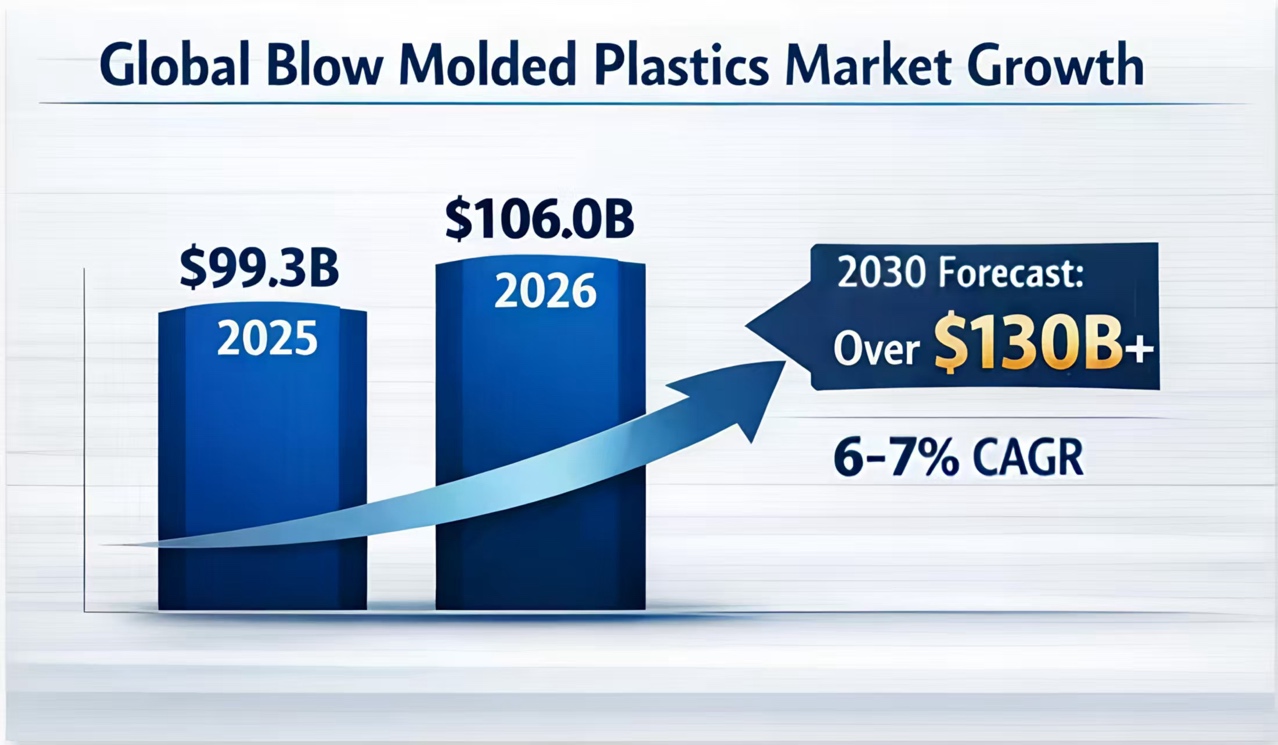
The global blow molding industry enters 2026 with sustained structural momentum rather than cyclical recovery dynamics. According to industry research, the global blow-molded plastics market is projected to increase from approximately USD 99.3 billion in 2025 to USD 106.0 billion in 2026, reflecting annual growth above 6%. Medium-term forecasts indicate the market could exceed USD 130 billion by 2030, supported by diversified end-use demand and continued industrial modernization.
This trajectory underscores blow molding’s strategic resilience within the broader plastics processing landscape. Demand is no longer driven solely by consumer expansion but increasingly by industrial efficiency, supply chain optimization, and regulatory transformation.
Market Scale and Material Structure
Blow molding remains a core processing technology for hollow plastic components across consumer, industrial, and technical sectors. Polyethylene (PE) continues to represent the dominant material category due to its cost-efficiency, chemical resistance, and compatibility with extrusion blow molding. Polypropylene (PP) maintains a strong position in rigid packaging and technical components requiring enhanced stiffness and thermal performance.
From an application standpoint, packaging remains the primary revenue driver, historically accounting for over 40% of global blow-molded plastics revenue. Food and beverage containers, personal care packaging, household chemical bottles, lubricants packaging, and industrial jerrycans collectively sustain high-volume demand. Structural growth in fast-moving consumer goods across emerging markets reinforces baseline consumption stability and production continuity.
Machinery Market Dynamics and Capital Deployment
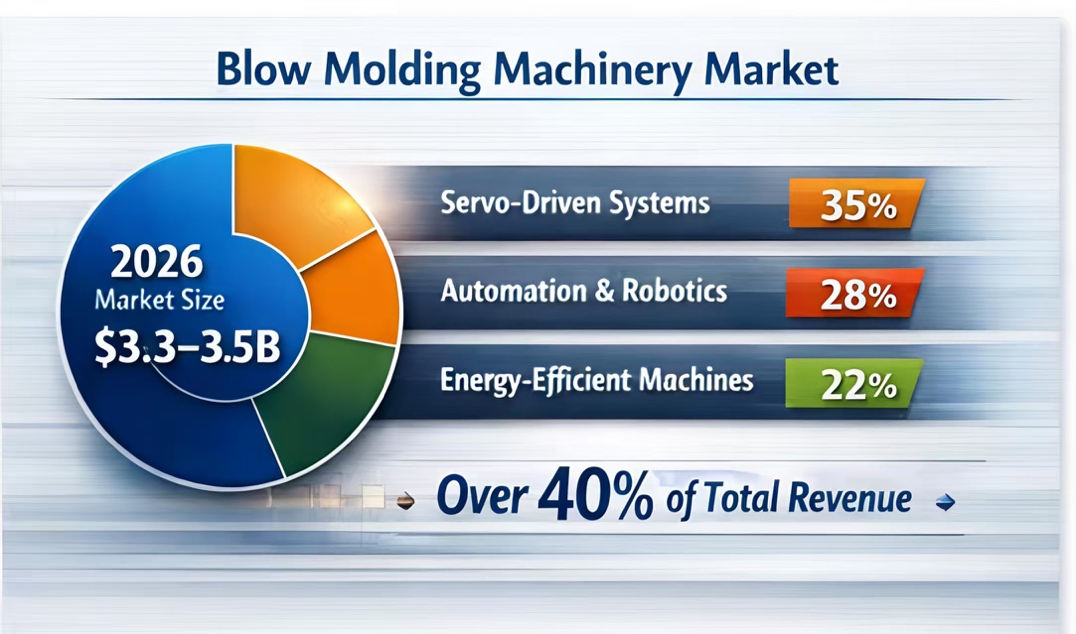
In parallel with material consumption growth, the global blow molding machine market demonstrates stable capital expenditure patterns. Industry estimates place machinery market value at approximately USD 3.3–3.5 billion in 2025–2026, with steady mid-single-digit annual growth projected through the decade.
Unlike earlier expansion phases driven by rapid capacity additions, the current investment cycle emphasizes equipment upgrading and operational optimization. Capital allocation increasingly targets:
· Servo-driven and energy-efficient systems
· Automated handling and robotic integration
· Digital production monitoring and data-driven quality control
In markets experiencing rising labor costs and tightening environmental regulations, automation investment is becoming structurally necessary to maintain competitiveness and margin stability.
Packaging as the Structural Demand Anchor
Packaging continues to anchor global blow molding demand. Rising consumption of packaged food, beverages, personal hygiene products, and household chemicals supports sustained output expansion. Emerging markets across Asia and Latin America are witnessing accelerated growth in lightweight plastic containers as retail distribution networks modernize.
Lightweighting strategies have significantly improved material efficiency. By optimizing wall thickness and improving mold precision, manufacturers reduce resin usage per unit while maintaining structural integrity. These engineering improvements strengthen blow molding’s competitive position relative to alternative rigid packaging solutions.
Industrial and Automotive Applications: Engineering Value Expansion
Industrial and automotive applications represent an important value-added segment of the market. Blow molding is extensively used to manufacture fuel tanks, fluid reservoirs, air ducts, and protective housings. In automotive manufacturing, lightweight polymer components support fuel efficiency targets and extended electric vehicle driving ranges.
As electrification accelerates, the relevance of blow molding evolves rather than diminishes. Thermal management systems, coolant reservoirs, and battery-related fluid storage components increasingly rely on high-performance blow-molded structures.
Large-format industrial containers and intermediate bulk packaging solutions also continue expanding across chemical processing, agriculture, and food supply chains, reinforcing the technology’s role in global logistics infrastructure.
Regional Power Centers and Growth Differentiation
Asia-Pacific remains the dominant production hub, accounting for approximately 35–40% of global market share. China’s established manufacturing base, India’s expanding industrial capacity, and Southeast Asia’s export-oriented growth collectively anchor regional leadership. Supply chain diversification and domestic consumption growth further strengthen Asia-Pacific’s structural advantage.
North America represents a technologically advanced yet comparatively mature market. Growth is driven by automation upgrades, pharmaceutical packaging standards, and industrial reshoring initiatives. Europe leads regulatory transformation, with circular economy directives and recycling mandates accelerating demand for machinery capable of processing higher levels of recycled polyolefins.
Digitalization and Industry 4.0 Integration
Competitive differentiation increasingly depends on digital capability. Advanced production lines integrate real-time process monitoring, predictive maintenance analytics, and automated defect detection. These technologies reduce scrap rates, improve uptime, and enhance traceability — critical in regulated sectors such as healthcare and food-grade packaging.
Energy efficiency has emerged as a key operational metric. Servo-hydraulic and fully electric blow molding machines significantly reduce electricity consumption compared with traditional hydraulic systems. As global energy markets remain volatile, total cost of ownership calculations increasingly favor high-efficiency platforms.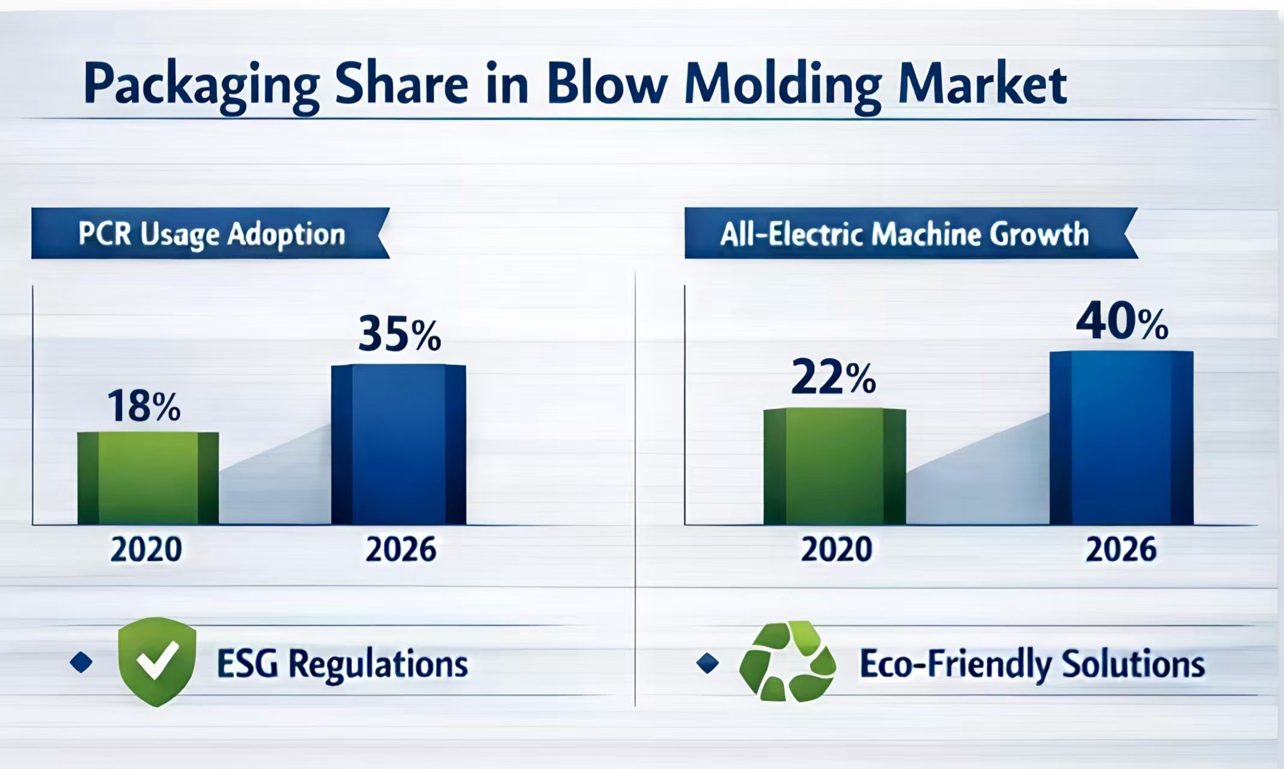
Sustainability Imperatives and Polyolefin Recycling
Environmental regulation and corporate ESG commitments are reshaping material strategies. The growing adoption of post-consumer recycled (PCR) polyethylene and polypropylene is transforming production requirements. Machinery must maintain dimensional accuracy and mechanical performance when processing recycled materials with variable melt characteristics.
Mono-material packaging strategies are gaining traction to improve recyclability and reduce contamination in waste streams. Equipment flexibility — particularly in extrusion blow molding platforms — becomes a decisive advantage in adapting to evolving sustainability standards.
However, regulatory scrutiny of single-use plastics, especially in Europe, introduces uncertainty in specific packaging categories. Companies must balance environmental compliance with performance, cost, and scalability considerations.
Risk Landscape and Competitive Pressures
Despite strong growth fundamentals, the blow molding industry faces identifiable risks. Resin price volatility directly impacts cost structures, particularly in high-volume packaging segments operating under long-term supply agreements. Geopolitical trade shifts and currency fluctuations add further complexity to global procurement strategies.
Alternative materials such as molded fiber and biodegradable composites are receiving policy support in select jurisdictions. While these materials currently address niche segments, they represent a medium-term competitive consideration.
Manufacturers with diversified geographic exposure, operational flexibility, and technology-driven efficiency advantages will be better positioned to mitigate risk.
Strategic Outlook for 2026 and Beyond
The 2026 outlook signals a structural transition from scale-based competition toward capability-based leadership. With global market value exceeding USD 100 billion and machinery investment maintaining steady expansion, industry fundamentals remain robust. However, future advantage will be defined by automation intensity, digital integration, and sustainable polyolefin processing capability.
Forward-looking manufacturers are prioritizing intelligent production ecosystems that combine servo-driven systems, robotics integration, real-time analytics, and PCR-compatible extrusion platforms. In a policy environment shaped by decarbonization targets and circular economy frameworks, operational adaptability becomes a strategic imperative.
Within this evolving landscape, Dawson Group is committed to serving as a long-term strategic partner for global converters and industrial manufacturers. Dedicated to delivering advanced blow molding systems and integrated turnkey solutions, Dawson Group focuses on enhancing productivity, optimizing lifecycle cost efficiency, and enabling clients to meet increasingly stringent sustainability standards. Through engineering expertise, system integration capability, and global service support, the company empowers customers to build resilient, future-ready manufacturing infrastructures.
As the industry advances into 2026 and beyond, competitive differentiation will depend not merely on installed capacity, but on technological sophistication and disciplined capital deployment. Organizations that combine forward-looking investment strategies with solution-oriented partners such as Dawson Group will be best positioned to capture disproportionate value in the next phase of global blow molding growth.