
Views: 0 Author: Site Editor Publish Time: 2025-11-28 Origin: Site


Blow molding is a popular manufacturing process used to produce hollow plastic products like bottles, containers, and automotive parts. The technique involves inflating a molten plastic tube inside a mold to create a desired shape. While blow molding offers numerous benefits, such as high production efficiency and the ability to produce complex shapes, it also comes with its share of challenges. Understanding the common problems that occur with blow molding products can help manufacturers troubleshoot issues, improve quality, and reduce waste.
In this article, we will explore some of the most frequent issues faced in blow molding, ranging from material defects to mold-related concerns. Additionally, we will discuss how to identify these problems, their root causes, and practical solutions to mitigate their impact on production.
One of the most common issues with blow molding is the creation of products with thin walls or inconsistent wall thickness. This problem can result in weak, brittle, or poorly formed products, which may not meet the required quality standards.
Root Causes:
Incorrect Parison Control: The parison (the molten plastic tube) needs to be extruded uniformly to ensure even wall thickness. If the parison is not properly controlled, it may lead to thinner or thicker sections in the product.
Mold Temperature Issues: Uneven or improper mold temperatures can cause variations in the cooling rates of different sections of the product, leading to inconsistent wall thickness.
Blow Pressure Problems: Insufficient blow pressure can lead to the expansion of the plastic being uneven, which can result in walls that are too thin or thick in certain areas.
Solutions:
Ensure consistent parison control by adjusting the extrusion process and monitoring the thickness regularly.
Maintain uniform mold temperatures by ensuring proper heating elements are functioning and monitoring temperature distribution across the mold.
Optimize blow pressure settings based on the material and product specifications to ensure even inflation.
Sink marks, or depressions on the surface of blow molded products, are another common issue that occurs during production. These defects typically appear as small, localized dents or indentations, which can affect the aesthetic quality of the product.
Root Causes:
Insufficient Cooling: If the product cools too quickly or unevenly, it can result in sink marks as the material contracts.
Inadequate Mold Design: A mold with poor cooling channels or improper venting can cause uneven cooling, leading to surface imperfections.
Incorrect Material Selection: Some materials are more prone to surface defects, especially if they are not adequately processed.
Solutions:
Review the Cooling System: To prevent sink marks, it’s essential to design the cooling system with uniformity in mind. Properly placed and well-calibrated cooling channels ensure even heat dissipation, reducing the risk of surface defects. The cooling process should be slow and controlled to allow for uniform material contraction.
Adjust the Material Formulation: Modifying the material formulation can help minimize the risk of shrinkage. Adding stabilizers or using materials with lower shrinkage properties can prevent the product from deforming as it cools. It's also important to ensure that the material is well-suited to the blow molding process, as using materials that don’t match the process parameters can increase the likelihood of defects.
Optimize Mold Design: Updating the mold design to include better venting systems and more effective cooling channels can reduce the occurrence of sink marks. The mold should be designed to facilitate even cooling and to eliminate pockets where heat might accumulate and cause uneven shrinkage.
Warping or deformation occurs when a blow molded product does not retain its intended shape after it cools. This problem is especially problematic in parts that need to meet specific dimensional tolerances.
Root Causes:
Uneven Cooling: If certain parts of the mold cool faster than others, the differential cooling can cause the product to warp.
Inconsistent Material Flow: Improper parison distribution or poor extrusion settings can cause parts of the product to be thicker than others, leading to uneven cooling and warping.
Mold Design Flaws: The shape and design of the mold can also contribute to uneven cooling and distortion if the design does not allow for proper thermal expansion.
Solutions:
Optimize cooling rates by improving mold design and ensuring that the cooling system is balanced and efficient.
Control the parison distribution to ensure a uniform wall thickness across the entire product.
Consider adjusting the material formulation or additives to reduce the likelihood of warping, especially when producing large or complex parts.
Flashing occurs when excess material spills out from the mold cavity during the blow molding process. This excess material forms unwanted thin layers along the edges of the molded product, which can be difficult to remove and may impact the aesthetic quality of the item.
Root Causes:
Excessive Blow Pressure: If too much blow pressure is applied, the material may push out of the mold cavity, resulting in flashing.
Incorrect Mold Clamping: Improper clamping force or uneven clamping pressure can cause the mold to open slightly during the blow molding process, allowing material to escape.
Mold Wear and Tear: Over time, molds may wear down or become damaged, leading to gaps that allow material to leak out during molding.
Solutions:
Carefully control blow pressure settings to ensure they are in line with material specifications.
Regularly inspect and maintain the mold to prevent wear and ensure that clamping forces are applied evenly.
Replace or repair molds as necessary to prevent gaps that lead to flashing.
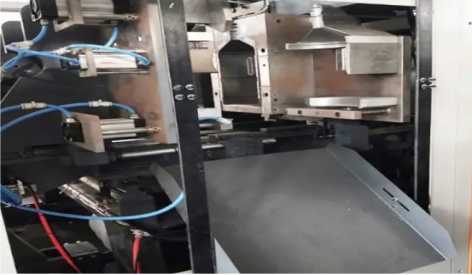
Poor part ejection can occur when the blow molded part sticks to the mold or has difficulty being removed from the mold after the cooling process. This issue can cause damage to both the product and the mold, leading to increased downtime and higher production costs.
Root Causes:
Insufficient Cooling Time: If the product is removed from the mold before it has fully cooled, it may still be too soft and prone to deformation.
Improper Mold Design: Molds without proper draft angles or ejection mechanisms can cause products to stick to the mold or require excessive force to remove them.
Inadequate Release Agents: In some cases, mold release agents may not be applied correctly, leading to adhesion issues between the product and the mold.
Solutions:
Ensure that the product has cooled sufficiently before ejection by optimizing the cooling time.
Modify mold design to include draft angles and ejection pins that help release the product without damage.
Apply mold release agents properly to ensure smooth product ejection.
Material contamination can be a significant problem in blow molding, especially when the raw material is not properly handled or stored. Contaminants can affect the product’s performance, appearance, and overall quality.
Root Causes:
Improper Material Handling: Materials that are exposed to moisture, dust, or other contaminants can cause inconsistent flow and quality issues.
Inconsistent Material Supply: Using materials from different batches or suppliers can lead to inconsistencies in color, texture, and performance.
Improper Storage Conditions: Storing materials in an environment that is too hot, humid, or otherwise unsuitable can affect the material’s integrity.
Solutions:
Implement strict material handling and storage protocols to minimize exposure to contaminants.
Use materials from the same batch and ensure consistency across production runs.
Store materials in temperature and humidity-controlled environments to maintain their quality.
Blow molding is an efficient and versatile manufacturing process, but it is not without its challenges. From wall thickness inconsistencies to material contamination, manufacturers must be aware of the common problems that can arise and take proactive steps to address them. By understanding the root causes of these issues and implementing the right solutions, manufacturers can optimize their processes, reduce defects, and improve the quality of their blow molded products.
At ZHANGJIAGANG DAWSON MACHINE CO., LTD., we specialize in providing high-quality blow molding machinery designed to meet the needs of a wide range of industries. Our machines are engineered for efficiency, precision, and durability, helping you achieve the best possible results with minimal downtime. For more information on how our products can enhance your production processes, contact us today.
The most common issues include thin walls, segregation, flashing, warping, and material contamination. These problems can affect the quality and consistency of blow molded products.
Flashing can be minimized by carefully controlling blow pressure, ensuring proper mold clamping, and maintaining molds to prevent wear.
Specific gravity affects the flow characteristics of materials during the blow molding process. Materials with varying specific gravities require different mixing, heating, and cooling strategies to ensure consistent results.
Proper mold design, including draft angles, cooling systems, and ejection mechanisms, is crucial for achieving high-quality products and preventing issues such as poor part ejection or uneven wall thickness.