
Views: 0 Author: Site Editor Publish Time: 2026-08-08 Origin: Site


When a parison cutter fails to sever extruded plastic cleanly, scrap rates spike, cycle times degrade, and unplanned downtime costs mount rapidly. This failure is rarely a simple mechanical nuisance. It serves as a complex symptom pointing toward deeper mechanical wear, thermal inconsistencies, or material degradation within the extrusion system. Addressing a cutter that refuses to cut requires looking beyond the blade itself to understand how the entire extrusion process interacts at the die head. Plant managers and maintenance engineers need a systematic, evidence-based diagnostic framework to isolate the root cause of cutting failures. By evaluating physical symptoms at the die head, you can determine whether the issue stems from pneumatic pressure drops, improper melt temperatures, or contaminated resin. This guide provides actionable steps to diagnose cutting malfunctions, evaluate intervention requirements, and decide whether a component repair, a system retrofit, or a complete replacement is necessary.
Mechanical vs. Process: Parison cutting failures are frequently misdiagnosed as dull blades when the root cause is often thermal (melt temperature) or pneumatic pressure drops.
Material Integrity: High moisture content, resin contamination, or improper regrind ratios alter melt viscosity, preventing clean separation at the die head.
Tooling and Alignment: Uneven plastic flow rates causing parison curl can physically misalign the parison with the cutting mechanism, necessitating die head adjustments rather than cutter replacement.
Intervention Economics: Chronic cutting failures on legacy equipment often justify the ROI of retrofitting with servo-driven cutters or upgrading the parison programming system to eliminate bottlenecking.
Optimal cutting in a blow molding machine relies on several baseline metrics that must be met during every cycle. A successful cut achieves precise separation of the plastic tube without any stringing or tailing. It ensures a consistent parison drop weight, which is absolutely critical for maintaining strict control over wall thickness distribution. Furthermore, the cutting action must occur with zero interference to the mold closing speeds. When the blade actuates, it must slice through the molten polymer swiftly, allowing the parison to drop perfectly straight into the mold cavity before the platens clamp shut. Any deviation from this sequence compromises the structural integrity of the final molded part.
Achieving this clean cut requires perfect synchronization between the extruder output, the parison programmer, and the cutting mechanism. The blade must travel at a specific velocity to shear the plastic rather than push it. If the blade moves too slowly, the plastic will stretch and deform. If it moves too fast without adequate force, it may bounce or deflect off a thick-walled parison. Maintenance teams must establish a baseline for stroke speed, blade temperature, and actuation timing to ensure the cutting process remains stable across different resin batches and ambient plant conditions.
Cutting failures manifest in several distinct physical ways on the production floor. The most common symptom is plastic stringing, where a thin, angel-hair thread of polymer remains attached to the die head after the blade passes. Parison curl is another major indicator, where the extruded tube bends outward or inward, moving out of the cutter's designated path. You may also observe poor welds or pinch-offs at the base of the container, indented parting lines, or complete bottle blow-outs during the inflation stage.
Secondary pinch-off defects in the mold cavity often occur when the parison tail is dragged or misaligned due to an incomplete cut. Operators might notice plastic buildup on the blow pins or excessive flash that requires manual trimming. These symptoms often appear gradually. A blade might cut perfectly for the first few hours of a shift, only to start stringing as thermal expansion alters the die head gap or as pneumatic pressure fluctuates in the plant's main air supply.
Visible Defect | Immediate Production Impact | Probable Sub-System Failure |
|---|---|---|
Plastic Stringing (Angel Hair) | Contaminates mold cavity, blocks exhaust vents | Low cutter stroke velocity or excessive melt temperature |
Parison Curl (Bending) | Misaligns parison in mold, causes uneven wall thickness | Uneven die gap, degraded resin in die head, or draft drafts |
Torn or Ragged Cut Edge | Weak pinch-off welds, bottom blow-outs during inflation | Dull blade, mechanical deflection, or cold melt temperature |
Delayed Parison Drop | Interferes with mold closing, crushes parison | Sticking pneumatic valves or delayed PLC signal |
Ignoring chronic cutting issues compounds financial losses rapidly. The immediate impact is wasted virgin resin and an increased need for regrind processing, which degrades the overall material properties over time. Every scrapped bottle represents lost machine time, wasted energy, and reduced overall equipment effectiveness. Beyond material waste, a dragging or stringing parison can cause severe physical damage to the mold cavity surface.
Plastic buildup on the pinch-off edges prevents the mold from closing properly. When the platens attempt to lock over this hardened plastic, it creates immense structural stress on the clamping mechanisms and tie bars. Over time, this forces premature mold resurfacing, repairs to peened pinch-off edges, and extensive mechanical rebuilds of the clamp linkages. Addressing a cutting issue early prevents a minor tooling adjustment from escalating into a major mechanical overhaul.
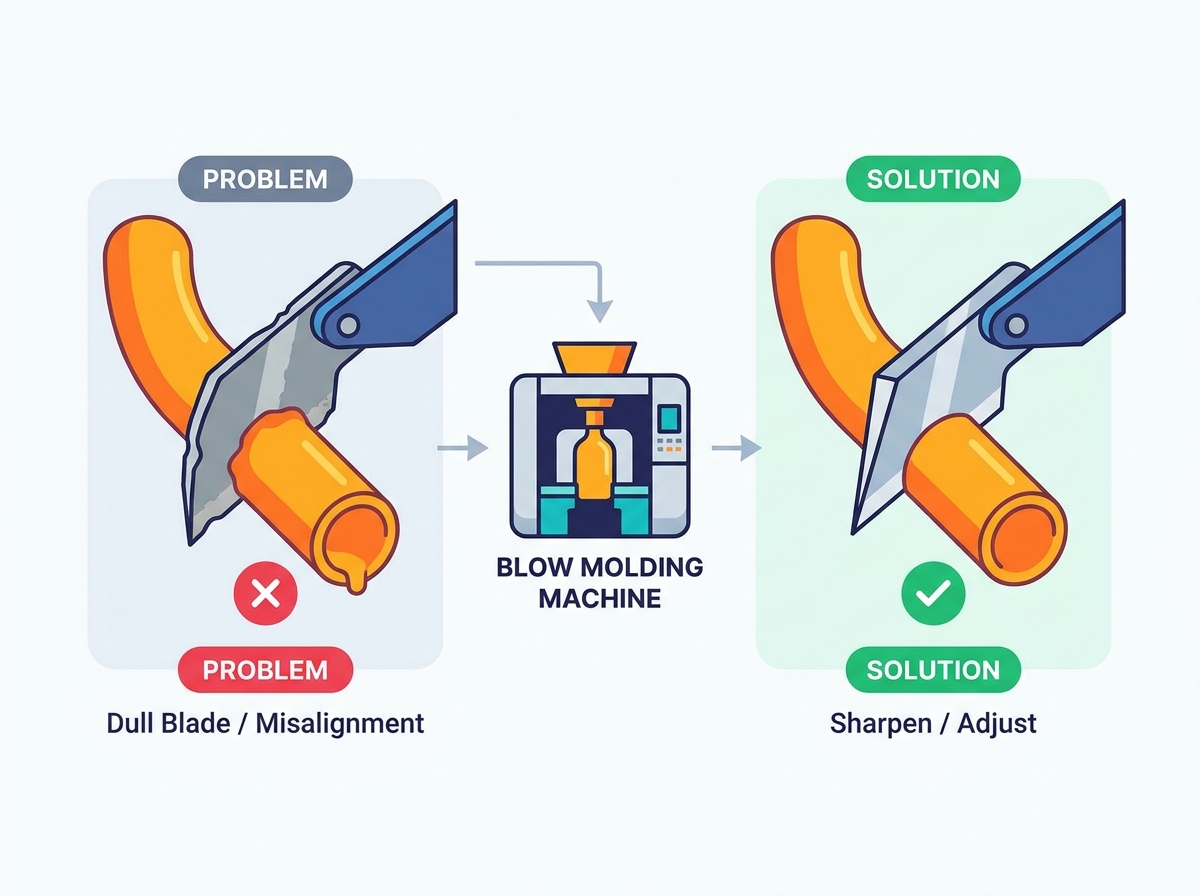
Diagnosing mechanical failures begins with a thorough, hands-on inspection of the hot knife or cold knife mechanisms. Look for micro-abrasions, dulling, and physical misalignment relative to the die head. A blade that is even slightly off-center will push the parison rather than slicing it. Technicians should use a straightedge and feeler gauges to verify the blade's travel path is perfectly perpendicular to the extruded tube. Any angular deflection will cause the blade to drag across the plastic, creating a ragged edge that compromises the pinch-off weld.
Assess the load limits placed on the cutting mechanism. When the wall thickness or parison weight is too high, it places excessive shear load on the blade. This accelerates edge degradation and causes mechanical deflection during the stroke. Heavy-walled parisons require robust, high-speed cutting mechanisms. If you are running a lightweight machine setup for a heavy industrial container, the standard pneumatic cutter will likely stall or deflect mid-stroke.
Pneumatic and hydraulic system integrity plays an equally vital role in cutting success. Evaluate the actuation systems by measuring pressure drops across the air lines during the cutting stroke. Identify worn cylinders, leaking rod seals, or exhausted mufflers that reduce the cutting stroke velocity. If the blade lacks the necessary speed to sever the parison cleanly, it will drag the plastic.
Connect an inline pressure gauge directly to the cutter cylinder inlet to monitor dynamic pressure drops during actuation.
Inspect the directional control valves for sticking spools or delayed response times.
Check the cylinder rod for scoring or pitting, which indicates internal seal failure and loss of stroke force.
Verify that the plant's main air compressor is supplying consistent volume, not just static pressure, to the machine manifold.
Examine the mechanical linkages connecting the cylinder to the blade holder for excessive play or worn bushings.
Melt temperature dictates the viscosity and structural integrity of the extruded plastic. When the temperature is too high, the plastic stretches and gums up on the blade, making a clean cut impossible. The polymer loses its melt strength, acting more like a liquid than a pliable solid. Conversely, a temperature that is too low increases resistance beyond the cutter's mechanical capacity, leading to cold-slug cutting resistance and poor pinch-off welding in the mold. The blade will struggle to penetrate the stiff plastic, often tearing it instead of cutting.
Optimizing the stock temperature requires gradual, methodical process adjustments. Raise or lower the extruder zone temperatures in small increments (typically 5 to 10 degrees) to prevent degrading the polymer while ensuring the melt has enough structural integrity to withstand the blade's impact. Use a handheld pyrometer to measure the actual melt temperature as it exits the die, rather than relying solely on the barrel thermocouple readings, which can be inaccurate due to shear heating.
Old resin stuck inside the extruder die head creates significant complications. This degraded, carbonized material disrupts the flow, causing uneven plastic flow rates around the circumference of the die opening. This uneven flow results in parison curl, physically moving the plastic out of the cutter's optimal path. Regular purging with commercial purging compounds and scheduled die head teardowns are necessary to remove this buildup and restore concentric flow.
Thermal Condition | Effect on Parison | Effect on Cutting Action |
|---|---|---|
Excessive Melt Temperature | Low melt strength, excessive sagging | Blade gums up, plastic strings and sticks to tooling |
Insufficient Melt Temperature | High viscosity, stiff parison | Blade stalls, plastic tears, high mechanical stress on cylinder |
Uneven Die Head Heating | Parison curls toward the colder side | Parison moves out of blade path, resulting in partial cuts |
A poor or worn mold cavity surface finish and an overly sharp pinch-off design interact negatively with poor cutting. If the parison is already compromised by a ragged cut, a sharp pinch-off can sever the plastic prematurely during mold closing, causing blow-outs. The pinch-off must compress and weld the plastic, not cut it like a knife. Inspect the pinch-off lands for proper width and ensure they are not peened over from slamming shut on cold plastic.
Evaluate the synchronization between the parison drop, cutting actuation, and mold closing. Molds closing too fast can snap the parison before the cutter fully retracts, damaging the cutting assembly and ruining the part. Adjust the mold close deceleration valves to ensure the platens slow down just before the pinch-off engages. This allows the plastic to flow into the flash pocket properly, creating a strong weld regardless of minor cutting imperfections.
Excess moisture in the resin creates steam pockets within the melt stream. As the plastic exits the die head and hits atmospheric pressure, these pockets expand and pop, altering the structural integrity of the parison. This makes it incredibly difficult for the blade to cut cleanly, often resulting in severe physical stringing, erratic parison behavior, and surface defects known as splay. Proper desiccant drying protocols must be strictly enforced to eliminate moisture before the resin enters the feed throat.
Verify the desiccant dryer is maintaining a dew point of at least -40 degrees.
Check the dryer return air filters for dust buildup that restricts airflow.
Ensure the resin residence time in the drying hopper meets the material manufacturer's specifications.
Conduct regular moisture analyzer tests on the resin just before it enters the extruder throat.
Degraded polymers, foreign matter, or cross-contamination from the regrinder severely impact the blade's ability to slice through the extruded tube without nicking. Contaminants create hard spots in the melt that deflect the blade or cause the plastic to tear rather than cut. Assess your regrind ratios carefully. High percentages of recycled resin or sudden changes in the melt flow index (MFI) change the parison's behavior at the exit point. These material variations require immediate cutter speed adjustments, blade temperature modifications, or cycle timing recalibrations to maintain a clean separation.
Legacy pneumatic cutters often struggle to keep up with the precision required for modern manufacturing. Map the limitations of your current pneumatic setup against the reliability of modern servo-driven cutting mechanisms. Servo cutters offer precise velocity control and repeatable positioning, eliminating the pressure drop variables inherent in pneumatic systems. Evaluate how upgrading the cutting system impacts the machine's ability to handle advanced engineered resins, high-ratio regrinds, or lightweighting initiatives that demand absolute parison control.
Weigh the immediate capital expenditure of a die head or cutter retrofit against the ongoing labor and scrap costs associated with chronic maintenance. While a retrofit requires upfront investment, it stabilizes production and reduces the burden on maintenance staff. Address the downtime required for a retrofit by developing a strict mitigation strategy. Schedule preventative maintenance audits and partner with OEMs for drop-in replacement modules. This approach minimizes offline time and ensures a smooth transition to upgraded cutting technology without disrupting long-term production schedules.
Use the following steps to resolve cutting failures effectively and restore machine efficiency:
Audit extruder zone temperatures and verify actual melt temperatures using a handheld pyrometer to ensure optimal viscosity.
Inspect the pneumatic cylinders, valves, and air lines for pressure drops that reduce cutter stroke velocity.
Purge the die head thoroughly to remove degraded resin and correct uneven plastic flow rates causing parison curl.
Verify desiccant dryer performance to eliminate moisture pockets that compromise parison structural integrity.
Evaluate the mechanical alignment of the blade and replace any tooling showing signs of micro-abrasions or deflection.
A: Parison curl is typically caused by an uneven plastic flow rate around the circumference of the die opening. This often results from old, degraded resin stuck inside the die head or improper tooling alignment. The uneven flow forces the extruded tube to bend, moving it out of the cutter's designated path.
A: If the melt temperature is too high, the plastic becomes overly sticky, causing it to stretch and gum up on the cutting blade. If the temperature is too low, the plastic becomes too rigid, increasing cutting resistance and causing poor, weak pinch-off welds at the base of the container.
A: Blade lifespan depends on the resin type, wall thickness, and cycle volume. Abrasive resins or high-weight parisons dull blades faster. Inspect blades weekly for micro-abrasions or deflection. Replace or sharpen them as soon as you notice plastic stringing or tearing during the cut.
A: Yes. Excess moisture creates steam pockets that disrupt the parison's structural integrity, leading to stringing. Contamination or high ratios of recycled regrind alter the melt flow index, creating hard spots or inconsistent viscosity that prevents the blade from slicing cleanly through the plastic.
A: A hot knife is heated to melt through the plastic, sealing the edges slightly as it cuts, which is useful for specific resins prone to tearing. A cold knife relies entirely on mechanical sharpness and high stroke velocity to sever the parison without applying additional heat.
A: Fixing uneven flow requires purging the extruder with a commercial purging compound to remove degraded material. If purging fails, a complete die head teardown and manual cleaning are necessary. Afterward, recalibrate the die gap to ensure concentricity and uniform flow around the tooling.
A: If a mold closes too fast, it can slam shut and prematurely snap a parison that wasn't cut cleanly, causing blow-outs. An overly sharp pinch-off can sever the plastic too aggressively during clamping, weakening the weld line and ruining the part if the parison tail is misaligned.